
Meconium Aspiration: How ECMO and NICU Care Helped Vivian Recover
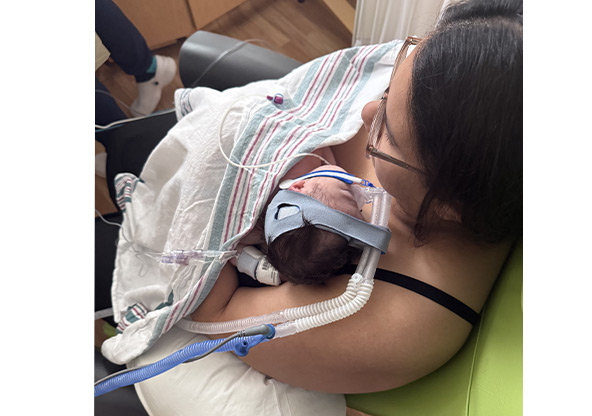
Ashley Yanes had a “perfect” pregnancy and expected to have a typical delivery. But just moments after Vivian was born, it was clear something was wrong. Vivian spent the next five weeks in the Neonatal Intensive Care Unit (NICU) at CHRISTUS Children’s.
There were no complications during labor,
Ashley explained. We had no reason to think something was wrong with Vivian until she was born. She was trying to cry out, but couldn’t, and she looked a little blue.
Within moments, the Labor & Delivery team at CHRISTUS Santa Rosa Hospital in Westover Hills placed Vivian on breathing support and transferred her to the NICU. Not only had Vivian swallowed a significant amount of amniotic fluid, but she had also inhaled meconium, a baby’s first stool, resulting in a condition known as meconium aspiration syndrome.
What is Meconium Aspiration Syndrome in Newborns?
Meconium is thick and irritating,
explained Dr. Cody Henderson, neonatologist at CHRISTUS Children's.
When it gets into the airways, it can block airflow and cause inflammation, making it very difficult for a newborn to breathe. After Vivian was born, she was placed on a continuous positive airway pressure machine, commonly known as CPAP, to support her oxygen levels and help protect her lungs from further injury.
Vivian was born just before 6 p.m., and I was able to visit her in the NICU around midnight,
Ashley recalled. That’s when I learned that Vivian’s condition had gotten worse and that she needed to be transferred to CHRISTUS Children’s.
Children's NICU
CHRISTUS Children's NICU
The Level IV NICU at CHRISTUS Children's in San Antonio offers advanced care for newborns and their families, especially babies born prematurely or with special medical conditions.
Rapid Transfer to CHRISTUS Children’s for Advanced Level IV NICU Care
While the inhalation of amniotic fluid and meconium affected Vivian’s lungs and ability to breathe on her own, the meconium also led to a bacterial infection.
The combination of lung injury and infection meant that Vivian needed more serious intervention,
Dr. Henderson explained. We needed to reduce the workload for her lungs so that they could heal while we also treated the infection.
What is ECMO?
Less than a day old, Vivian was placed on extracorporeal membrane oxygenation, or ECMO, a highly specialized form of life support available at CHRISTUS Children’s.
In the body, the heart pumps blood to the lungs, where the blood releases carbon dioxide to be breathed out, picks up oxygen that has been breathed in and transports it throughout the body,
explained Dr. Henderson, who also serves as the director of the Neonatal ECMO program at CHRISTUS Children’s. ECMO provides external heart and lung support. We pump blood out of the body, through an artificial lung to remove carbon dioxide and add oxygen, then pump it back into the body.
After being discharged, Ashley went straight to CHRISTUS Children’s to be with Vivian.
I broke down when I first saw Vivian on ECMO,
Ashley recalled. It was hard to see her with so many tubes and surrounded by machines. But she was also surrounded by nurses and doctors who were on top of everything, and it was very comforting to know that she was in good hands.
ECMO can be very overwhelming for parents,
Dr. Henderson said. The baby is sedated while on ECMO and can’t be held, but I remind parents that ECMO is temporary and, for babies with meconium aspiration syndrome, the outcomes are very encouraging. With ECMO support, survival rates are over 90 percent.
NICU Recovery After ECMO
I’m so grateful for Dr. Henderson,
Ashley said. He was very gentle and kind as he explained Vivian’s care and updated us on her progress. I remember he kept telling me, ‘She’s a strong baby, she’s doing good.’ His encouragement and the support from the entire NICU team helped me hold it together.
After five days, Vivian’s lungs were stronger and she was taken off ECMO, but her recovery was just beginning.
ECMO is an intense treatment, especially for a newborn, so we have a process to wean babies from full ECMO support to breathing on their own,
Dr. Henderson explained. They’ll spend time on a ventilator and CPAP before transitioning to a nasal cannula. A baby also needs time to learn how to suck and swallow so they can feed. Normally, that learning process begins right after birth, but for babies who require ECMO, like Vivian, it is delayed.
I was ready to go home, but I knew Vivian wasn’t,
Ashley said. She made progress every day, and that was the encouragement I needed to make it day by day.
On Dec. 23, Vivian was ready to go home—just in time for Christmas.
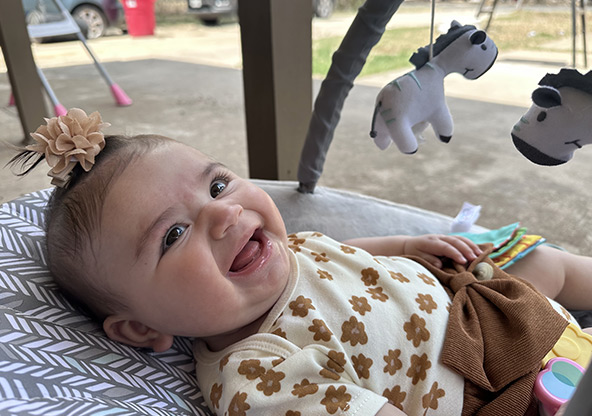
I was so happy,
Ashley recalled. Going home with her was the most amazing Christmas present. She was a little fussy at first. I think she missed the background noise of the NICU, but she’s gotten used to the quiet at home now. She’s getting chunky and loves to talk to herself.
I get a smile whenever I think about Ashley and Vivian,
Dr. Henderson said. Considering Ashley had just given birth, then having to go through Vivian’s ECMO treatment, it was amazing to see how calm and strong she was throughout. Vivian’s story is also a great example of how our system works together. The Westover Hills NICU team did an excellent job recognizing that Vivian needed specialized support and worked quickly to have her transferred to CHRISTUS Children’s.
At CHRISTUS Children’s, families facing unexpected complications are supported with advanced Level IV NICU care, specialized ECMO capabilities, experienced teams and a commitment to walking alongside them every step of the way.
To learn more about neonatal intensive care at CHRISTUS Children’s, visit CHRISTUS Children’s | NICU.
